Panasonic SJ-MR230 review
by Cory W 2025-08
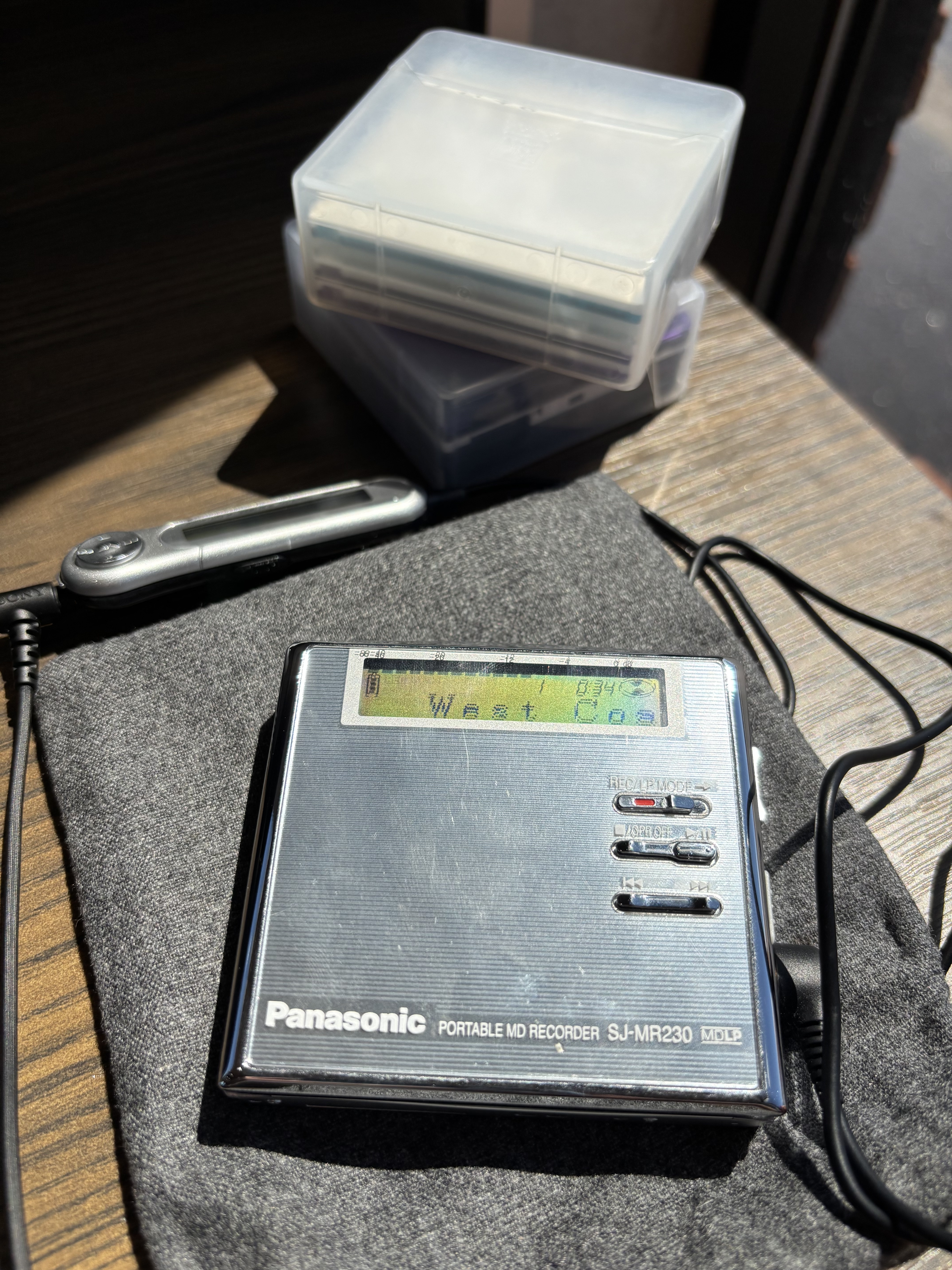
The Panasonic SJ-MR230 is a fun one. Everything about it screams "Japan in 2002" in almost every possible way. It's the collected epitome of Japanese Minidisc hardware, and why/how Minidisc succeeded the way it did in Japan.
General info about this machine is available on minidisc.wiki, use the SJ-MR250 manual, and Technical Initiative on YouTube has done a couple videos pertaining to fixes for this machine, including: Sensitive Buttons, Recording Slider, Battery Door,
The Background
Japan has what a lot of people refer to as Galapagos syndrome in terms of it's technology. It leads the development of miniaturization and digitization technologies, but unique aspects to it's culture and environment lead to things coming out different than in the west generally.
For starters, the Japanese commercial music recording industry and the legal environment of copyright law incentivize renting music, rather than buying it, and making copies of rented music at home. (In the US, home copying is explicitly legal, but there's not much ecosystem around renting music and copying borrowed music is sort of a gray area, from a legal perspective.)
So, Minidisc succeeding in Japan was a pretty obvious bet, as it provides a digital successor to the compact cassette for the optical disc era. If you're already used to renting CDs and recording them to tapes, upgrading to Minidisc (or even DAT, which saw higher consumer uptake in Japan than the rest of the world) makes perfect sense.
Because renting and sharing copies in physical format was already common, file trading might not take off quite as fast as elsewhere, and if your recording format is already good at portability, home usage, and mixtapes there's less urgent a need to move to a computer or file oriented format. There's also the whole deal about computers in Japan generally handling the Japanese language poorly for a long time. See Dan's great review of the MiniDisc DATA EATA for another great example of how this played out.
If it's 2001 or 2002, "Rip, Mix, Burn" doesn't have quite the same ring to it when you don't have a decade or two of purchased CDs, but rather up to a decade of recorded minidiscs, and you'd need to go back to the store to get the CDs again to rip them.
So, while NetMD, introduced at the tail end of 2001 in Japan and in 2002 in the rest of the world, and then further cost-reduced in 2003, was most of what drove "Peak Minidisc" outside of Japan, it wasn't a very big selling point in Japan.
So, in Japan Sony introduced the MZ-R910 after the MZ-N1, as a cost-reduced option without NetMD. Similarly, in June 2002 Panasonic introduced the SJ-MR250 with NetMD, and then in October, introduced the MR230 without NetMD at a lower price point.
The Machine
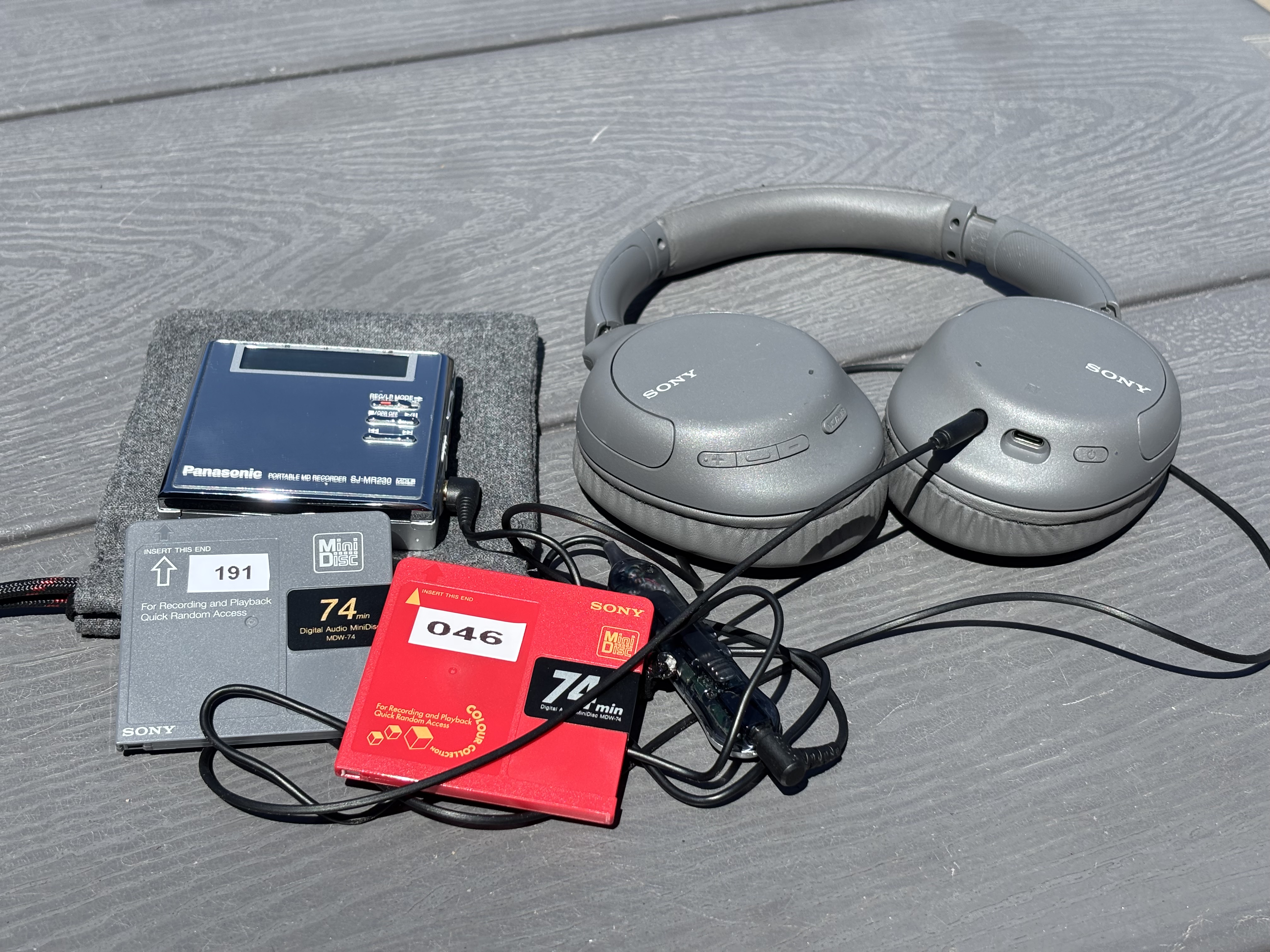
The MR230 is a good machine. Even though Panasonic joined the MiniDisc format relatively late, having been an early supporter of Philips' Digital Compact Cassette before it wrapped up in 1996, it's technology generally caught up with Sony and Sharp quickly.
The unit has a fairly normal feature set, As a gumstick (battery) machine, it's a little sleeker than most units powered by AAs, but as a midrange overall machine it's just a little thicker than some other gumstick recorders. It can record from a digital or analog line source, as well as from a microphone port. It has a single-line display, and Panasonic generally went out of its way to avoid menus onboard, but there is an editing menu when you connect the machine to it's dock.
The dock is arguably the draw to this machine. Without it, it's an MZ-R700 using worse batteries. The dock supplies external power to the unit, has controls (including a distinctive "calculator pad" group of keys used for entering titles) and allows the connection of a pair of small detached speakers. You could set up the system near your computer or on a work table and it'll sound decent. Probably better than most laptop speakers at the time, and if you're living in Japan in 2002 and you own a laptop, there's a high chance your music isn't on the laptop anyway.
The dock is also arguably the MR230's biggest downside, as you absolutely must have a working gumstick battery to use it, and because the machine will start attempting to charge the battery immediately upon being set on the dock: the gumstick absolutely must be a NiMH battery. If you put a NiCD battery in here, it will corrode, and if you put a USB-C gumstick replacer in this unit, it could damage the machine, the battery, or both.
The machine works with or without the speakers, when it's docked. The speakers are arguably part of the machine's unique charm. Sony didn't integrate audio into it's docks at all. Sharp integrated separate line outputs into it's docks, and the Panasonic included speakers were probably better than what's in most 2002-era laptops, but won't fill a room. You could arrange the setup on a table around a laptop, or at a table where you were working, or on a side table somewhere.
Unlike some of the player only "dockables with speakers" because the speakers here are separate, the kit doesn't travel very well, so look elsewhere if you need to do any editing on the road.
Compared to the Sony MZ-R910, it doesn't have some high end features like a real time clock, line-level output, speed control, or a 3-line display. Most of these things are primarily important if you're doing more advanced field recording.
The next biggest downside is, as a gumstick machine, it can use a sidecar with an AA battery inserted. The anchoring point for the sidecar is shared with most other Panasonic portable,s the SJ-MR100 through to the MR240/270 and MR50 should all share parts, but the attachment point feels less secure than most Sony or Sharp sidecars, so this machine is at it's best if you have at least one working nimh gumstick.
Recording
To me, the act of recording is the emotional and functional heart of MiniDisc as a format and a hobby. Smol disc cute, for sure, but what really clinched it for me was the zen I get from making a playlist within specific limits, or picking an album, and doing the recording, and then having the disc and being able to pick up the disc focus on later.
It, no joke, had a meaningful impact on how I use the format and how I listen to music, compared to my childhood of listening to random songs fetched one at a time in shuffle mode on iTunes and my young adulthood doing basically the same, but with streaming services.
Of course this isn't the only way I use the format, and MD isn't the only way to huff the recording vibe, but I think it's meaningful, and a good reason to shop around for a recorder, if you already have a NetMD burner.
Anyway, the SJ-MR230's ATRAC1 implementation is Panasonic's own. They call it HDES or High Density Encoding System. To me, it sounds the same as anything recorded in Sony's ATRAC1 v4.0, 4.5, or Type-R, and similarly mature Sharp codecs. I've heard reports some earlier Panasonic recorders use different encoding on battery and external power, but in my testing, the MR230's recordings sound good on battery or when running on the dock.
The act of recording is pretty different to a Sony. I mentioned earlier, the MR230 doesn't have an onboard menu system, so you pull the record lever to enter pause-record mode and then pull it again if you want to use LP2 or LP4. Then, hit the mode button on top to select between manual, sync, or sync 1 recording. If you're using analog or a microphone, those modes will be manual, automatic (track marks on 2 seconds of silence) or time-based marking at 3, 5, or 10 minutes. The third button lets you set the input gain and level controls, which you can only used while paused.
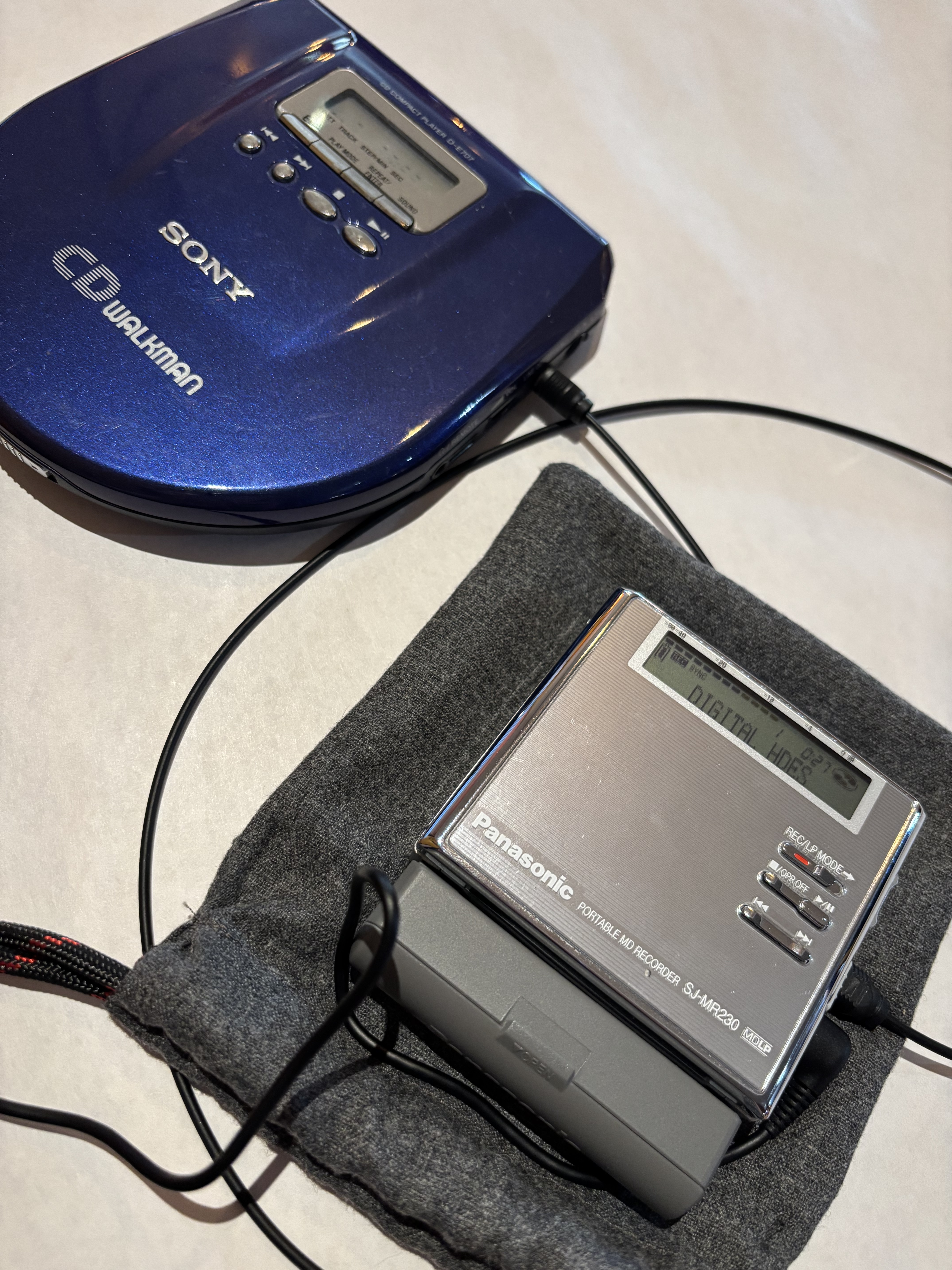
Then, either start your source (digital, sync) or hit play when you're ready and you're off to the races. If you're recording manually, you can hit pause as needed.
With a digital source, manual and sync do exactly what you'd expect. Sync 1 is a somewhat unique feature which is very indicative of the place and time. It's for recording just the first track of several CDs in a row. I used it to record humanity's weirdest mixtape from my Sony CDP-A39 and, the feature works well. I don't have many singles, and the CDs I had at hand were a very wide mix of genres and moods, but it was fun to do and I could 100% see how if I were renting a bunch of singles or building a disc full of new singles in a particular genre over time, this would be such a great feature.
Under normal sync recording, the MR230 works how you'd expect, with both CD sources and the digital output on my computer. I didn't happen to try manual mode with a digital source, but it should work fine.
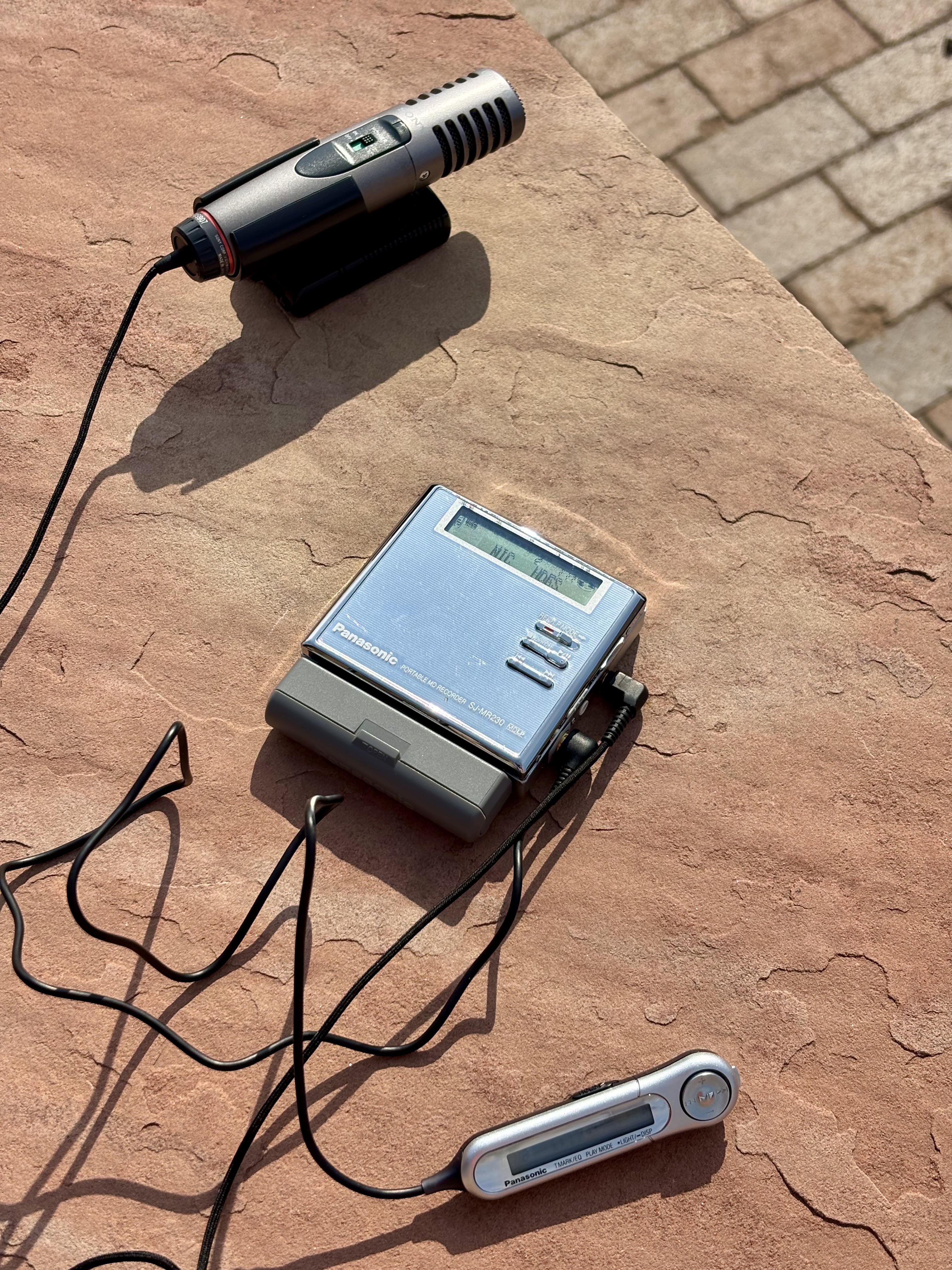
Recording off a microphone worked well enough. I took the SJ-MR230 and a Sony ECM-MS907 to a rail shunting yard a town over and in the low sensitivity auto-gain mode it accurately captured the trains without peaking or distortion. I likely could have tried high gain or manually adjusted the gain a little big higher, but I got usable results.
As a midrange machine, you can't adjust the gain during recording, but you can leave the recording session active and adjust it while the machine is paused. As with any MD recorder, really, judicious use of the pause button is a great way to split scenes and let you better adjust to what you're expecting next.
Editing
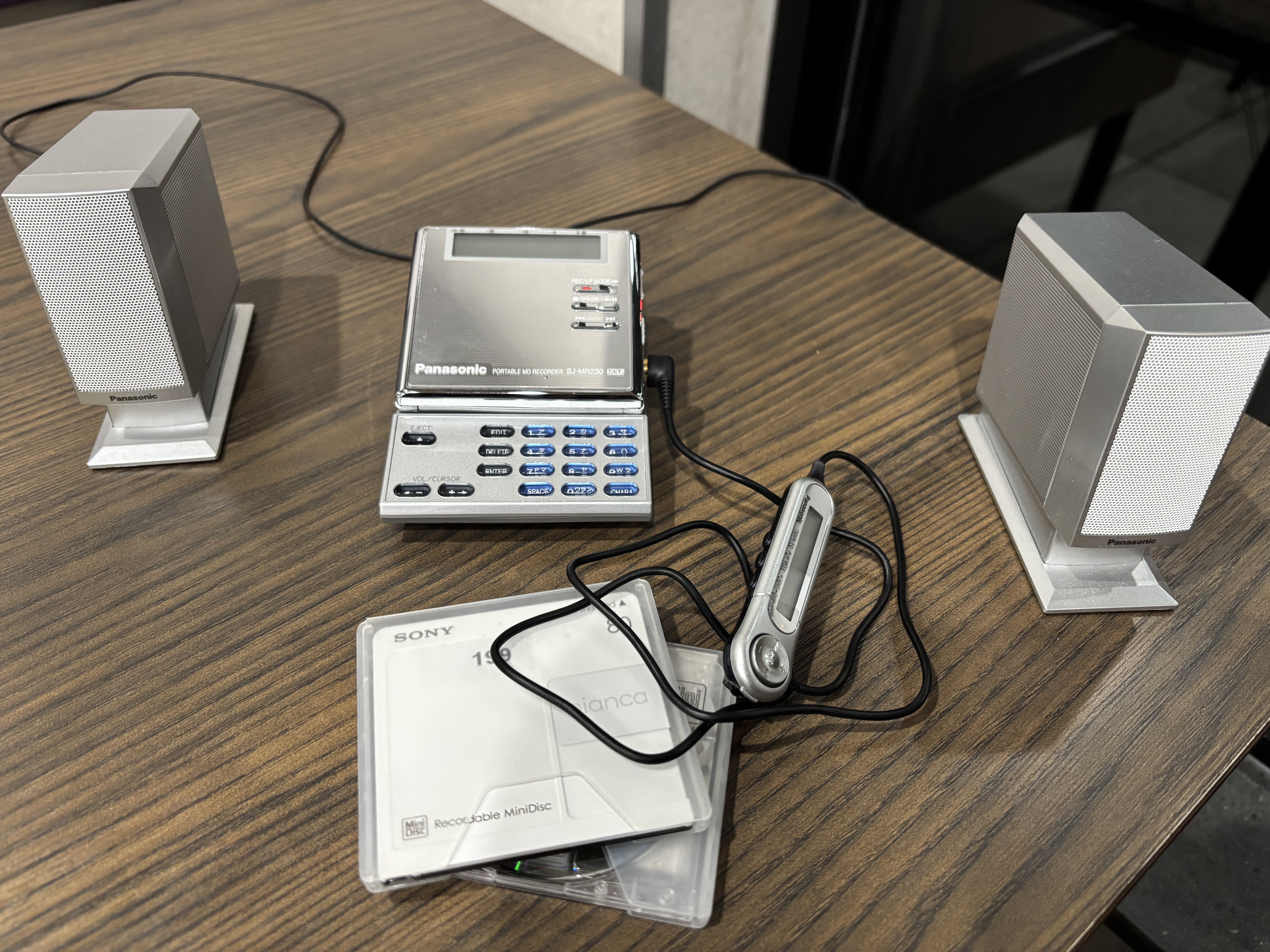
With the dock, you can do editing. Once docked, you get most of the same editing features as on any other portable recorder. You can erase individual tracks or the whole disc, enter titles for the disc or individual tracks, group and ungroup tracks, and a couple other normal editing features, such as rearranging the run order or deleting either individual tracks or wiping the whole disc.
The keypad is a somewhat novel text entry method on Minidisc. Not none, but not many other machines have something similar. As a Japanese machine, the default entry mode is kana, but you can swap to numbers or upper/lower-case numbers. It's more similar to titling with a 10-button deck remote than to something like most Sony portables, the AMS knob, or anything resembling a keyboard. It's probably specifically meant to simulate texting on a Japanese phone from the time. Once you get into a rhythm it should be possible to go faster than you might be able to on some other portables. I'm personally still faster on the RM-MZ4R I use with my MZ-R700 and B100, but a QWERTY keyboard or using a computer interface would of course be faster still. It's something you could learn though.
Probably the most unique editing feature this machine has, and again, "2002 in Japan", is a function to copy the track titles from one disc to another. The feature only works when the source and destination discs have the same number of tracks. So if you record a CD to two MDs or a mixtape to an MD, you can title one of them and use the MR230 to copy those titles onto another disc.
Why would you need to be able to copy titles? Today most people probably don't, but if you're in Japan in 2002: I can think of a handful of reasons, chief among them is SCMS (the digital copy protection scheme used on consumer digital audio recorders in most of the world) wasn't legally mandated in Japan, and although sold under highly euphemistic labels, digital audio copy status manipulators were available and legal in Japan. Or: Once you make a mixtape in whatever machine, it's legal and possible to copy a second generation digitally.
You could also use it to avoid having to type titles again on additional copies of an original source CD, say.
Playback
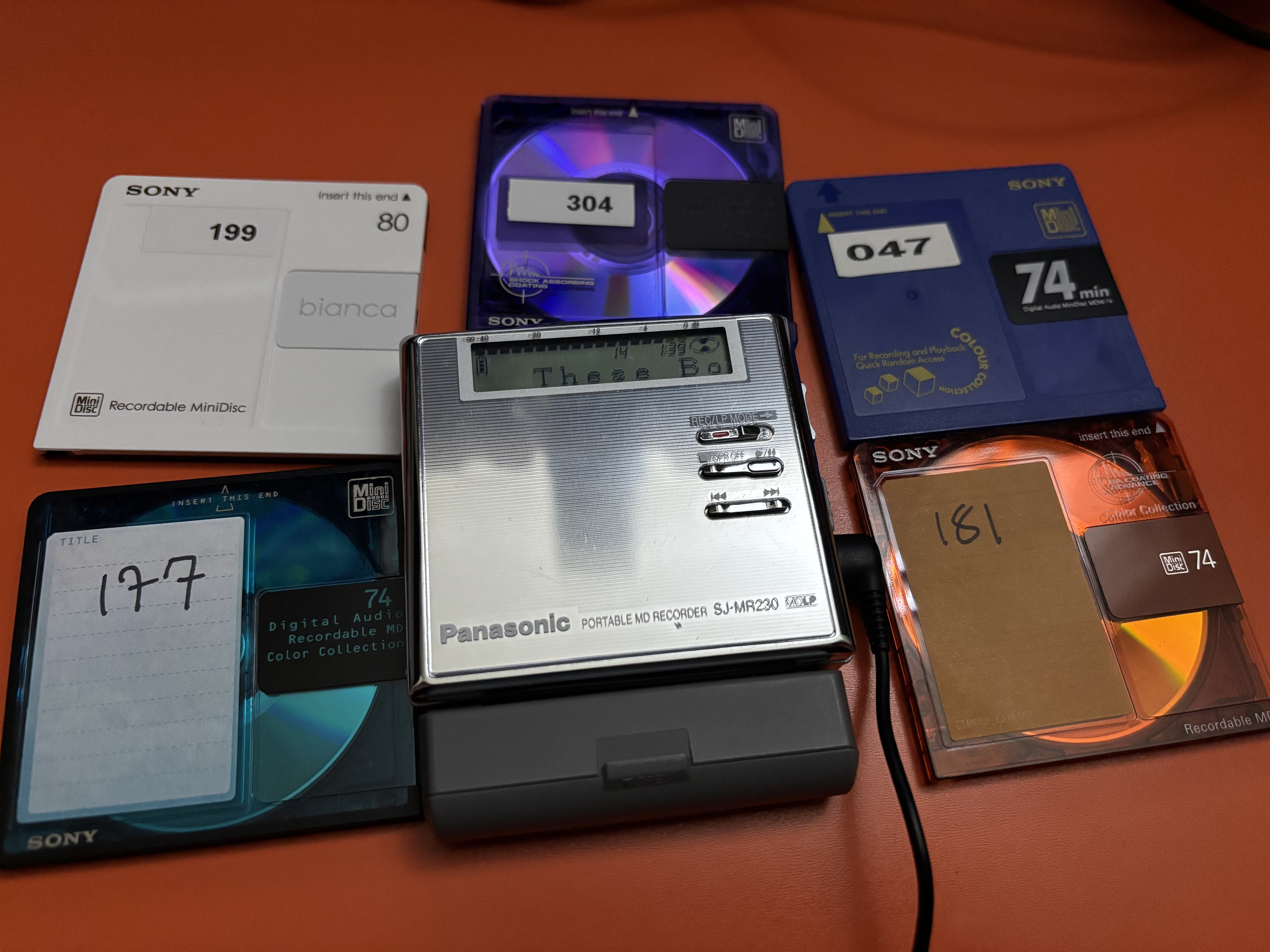
Playback works and sounds good. The SJ-MR230 has everything you'd expect out of a basic to midrange recorder in terms of playback.
It's got a couple useful EQ modes, loop 1, loop all, and random/shuffle playback modes, and you can skip back and forth to other track markers on the disc, and fast-forward or rewind within a track.
Perhaps the thing I miss most from higher end Sony recorders is the ability to navigate a disc while a track is playing, then navigate to the next track.
Controls
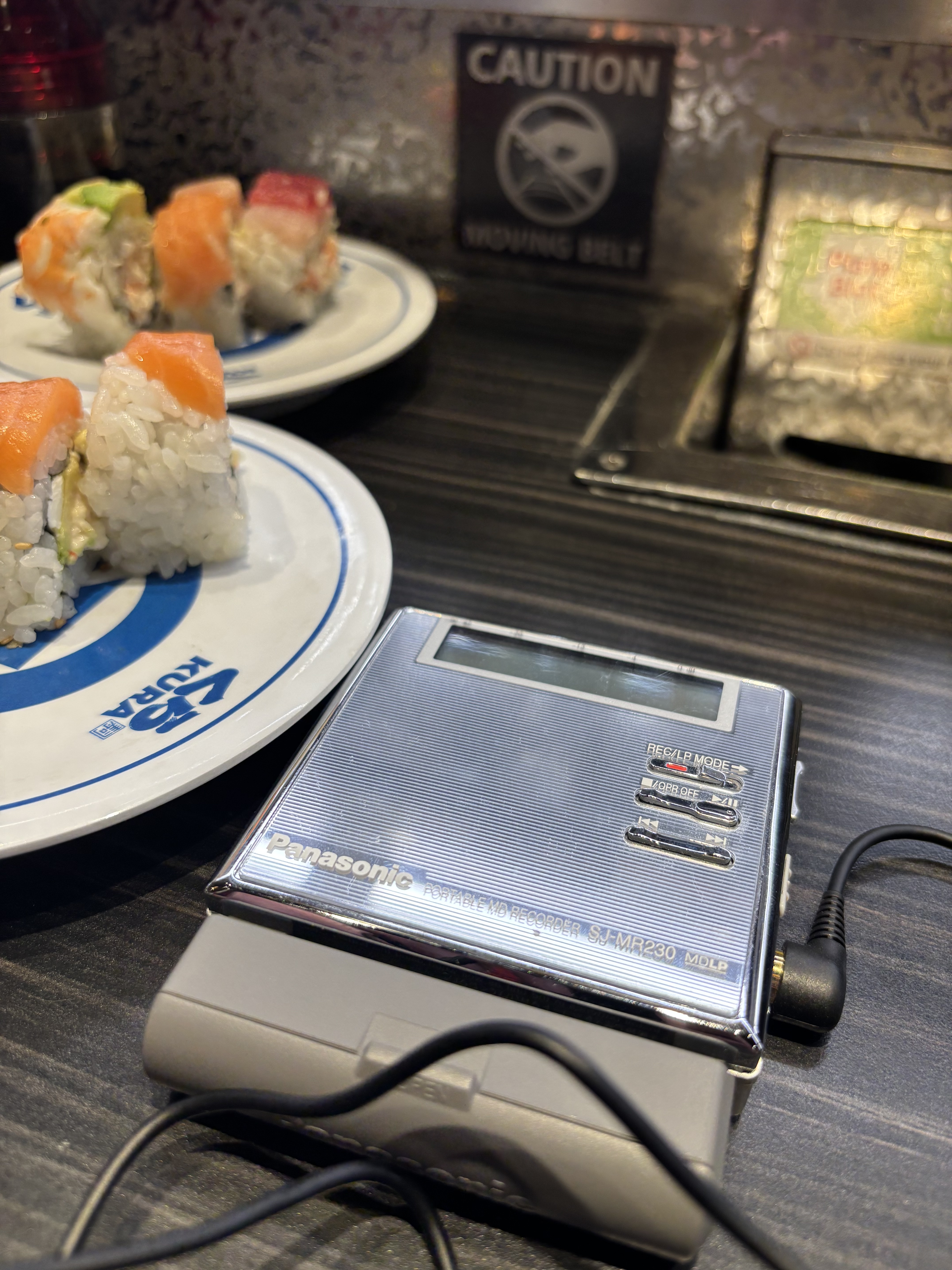
The machine has simple, easy controls. Play/pause, forward/back, and volume are front and center on the unit. Playback modes and EQ are available on the top.
It's a very simple machine to use. Panasonic managed to make a recorder with almost as few buttons as a player-only unit.
There's no menus onboard except for editing, which you can only use when the dock is attached. This has the upshot of meaning you won't accidentally wipe a disc, and the downside of meaning if you record something from your phone, you won't be able to split tracks without the dock.
Sound Quality
My machine sounds "good enough" to me using my Sony WH-CH710N headphones, wired, turned off. I have average hearing and a high tolerance for things some audiophiles measure carefully, so in my experience it's good enough.
Other machines measure better, but the SJ-MR230 is good enough in the context of minidisc as a format especially with regular headphones. Regardless of what machine you use, the classic MiniDisc is a lossy compressed format, but it is on the plateau.
Conclusion
The Panasonic SJ-MR230 is a good minidisc machine. If you'd like to buy one, I've got some notes on buying from Japan up on Reddit and the wiki has some notes as well.
For someone willing to work it into a larger ecosystem or deal with both sourcing and managing at least one working NiMH gumstick battery and the fundamentally pre-computer nature of the format, it does all the basics, and it does them well. It's got a couple foibles (the battery thing, really) and, with those in mind I don't think I'd recommend it as a first or only device unless you can find a complete unit in good condition, and give it a good battery.
If you don't have such an ecosystem environment, a Sony MZ-R700/701 or 900/909 may be a better starter option.
If your interest in MiniDisc is in any part related to it's place in Japanese culture or as a way to examine Japanese Galapagos-syndrome tech, the SJ-MR230 is a great way to show off what that meant, how it played out. It's a better representation of that aspect of the format than some other machines, specifically because of it's exclusion of NetMD.