Sharp MD-MS200 and Kenwood DMC-G7R - by The Technical Initiative
Overview
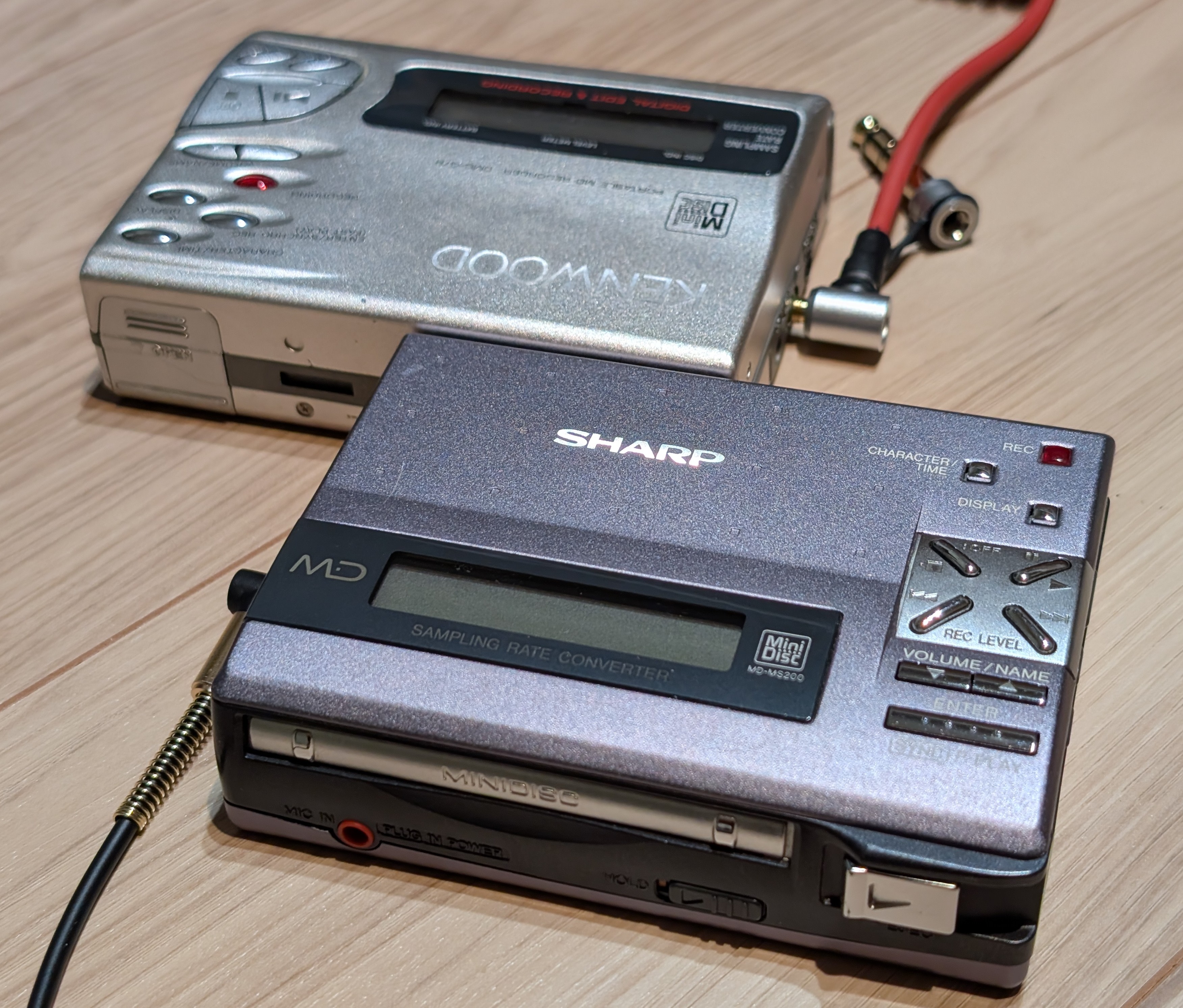
It sounds like a double-feature, but I’m cheating a bit since both of these portable recorders from 1997 are internally identical with a different fascia/casing and top panel button placement.
Sharp was the OEM for other electronics manufacturers including the previous generation of MiniDisc devices. Very early models and the predecessor, the Sharp MD-MS100, were also cloned by Kenwood, Denon, and Pioneer.
The Sharp MD-MS200 and Kenwood DMC-G7R are classic SP-only MiniDisc slot-loading recorders. They’re big and chunky by “modern” MiniDiscs standards. Until more miniaturization technology advanced, these rectangular designs were seen here and in Sony’s MZ-R30.
Related Instagram post: Photo Lineup of Portable Recorders from that Era
As we passed the year 2000, most portables were squarish and barely larger than a MiniDisc in a jewel case.
So why are these big, chunky slot loaders still so satisfying to use?
Well, slot-loaders will always hold a special place in my heart since my first portable was a Sharp MD-MS702, a chunky, but squarish slot-loader. Those familiar with that classic model may also know that it was conceived after these models we’re discussing today. That’s right, I only picked these units up a few years ago during the pandemic as my nostalgia was kicking in.
Anyway, let’s dig into why these big units are still part of my weekly rotation.
Design
These portable recorders are literal bricks only to be surpassed in sheer bulk by the Sony MZ-1 or perhaps the HHb Portadisc. Fully loaded with a battery and MiniDisc, you’ll think twice about putting this into a cargo pants pocket.
These unapologetically large rectangles have a metal case on the bottom and top plates with a LCD near the top front edge and controls just to the right of that. The leading edge has the MiniDisc slot and eject lever that slides to the right to eject. Few mechanisms are more satisfying than this loading/eject system.
The rear has no controls nor jacks, just a latching flap for a large rechargeable battery, similar to an 18650 lithium battery. More on that later.
They both came in two colors, silver and blue. The Sharp’s blue is a muted, grey/blue while Kenwood’s blue is a deep blue stunner that I wish I had in my collection.
Controls
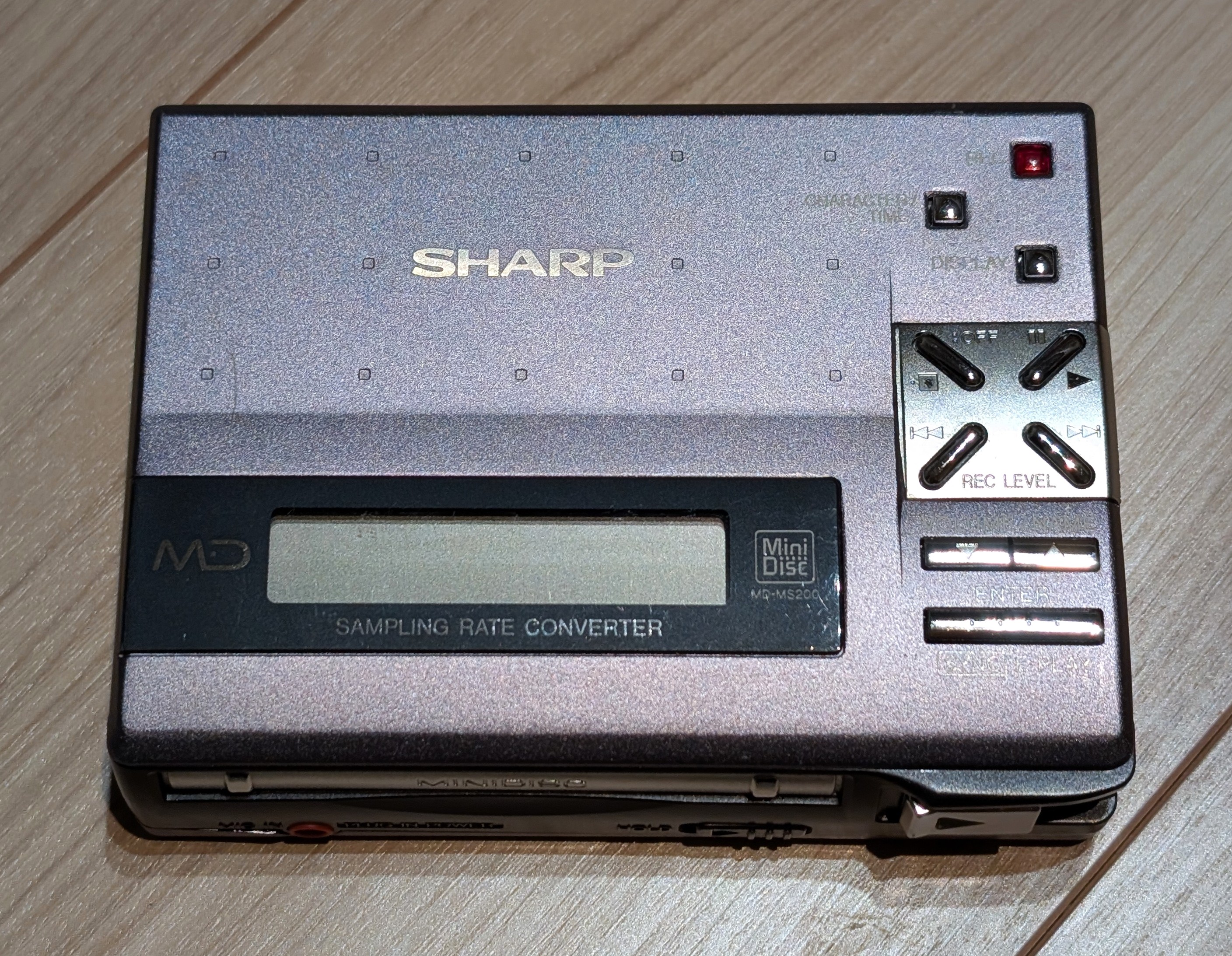
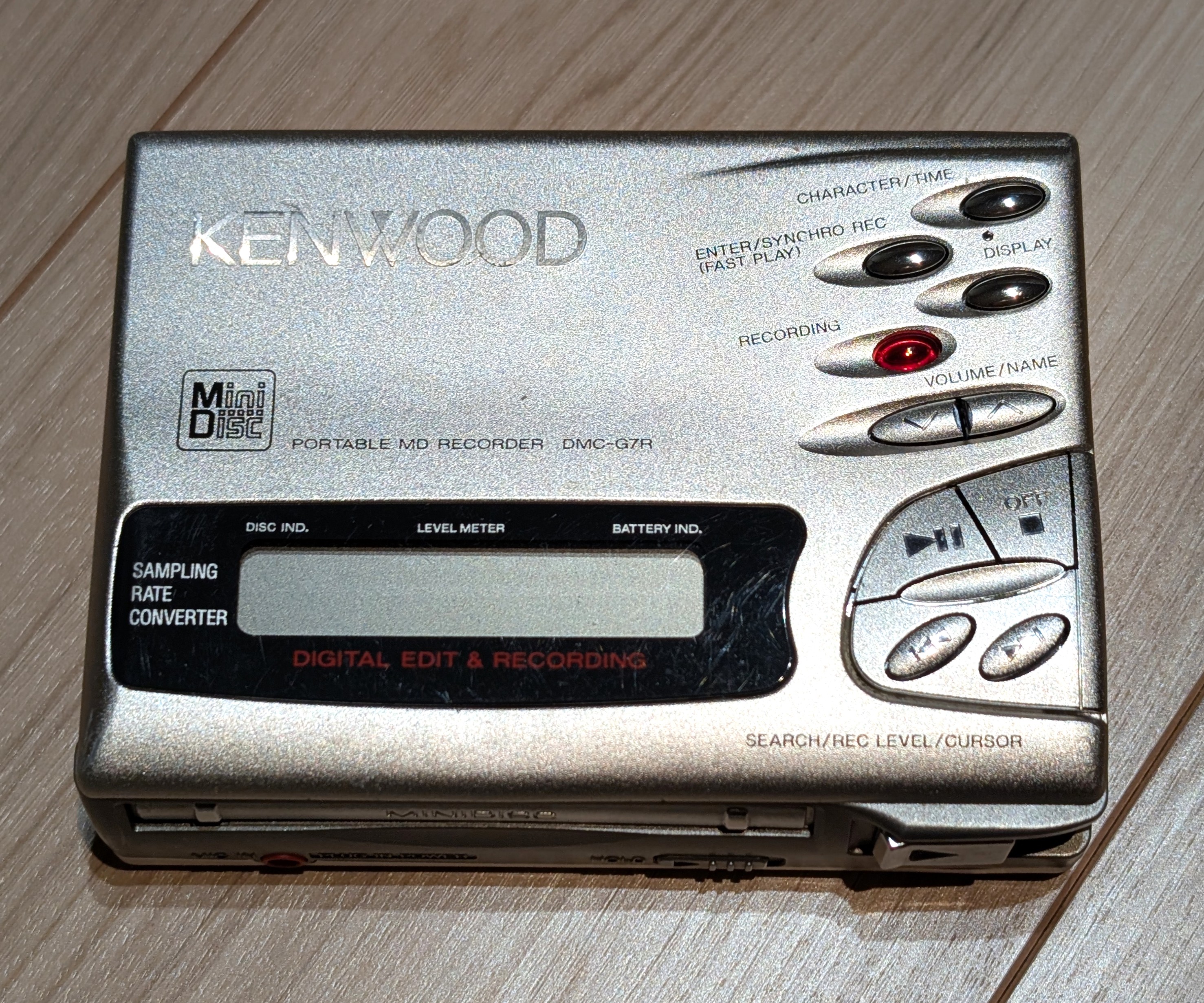
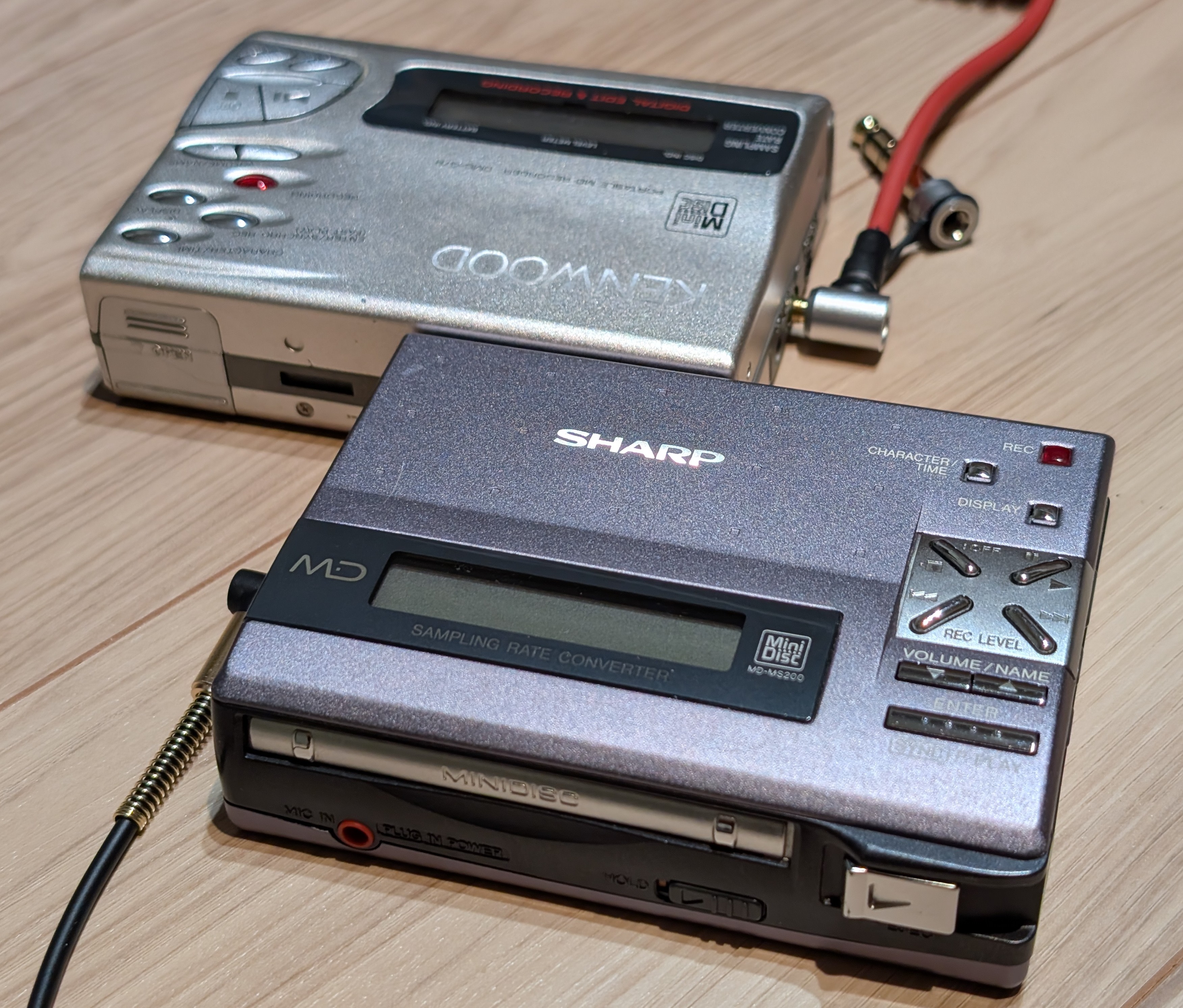
If we start at the top face, the controls for both models are laid out very similarly but with different aesthetic styling. Edge here to Kenwood for a more dynamic, rounded style, but the Sharp is no slouch with clean lines and a nice diagonal “X” pattern for Stop/Play/FF/FR.
The Sharp has volume controls below that cluster while the Kenwood places them just above the main controls. See the pictures for more details.
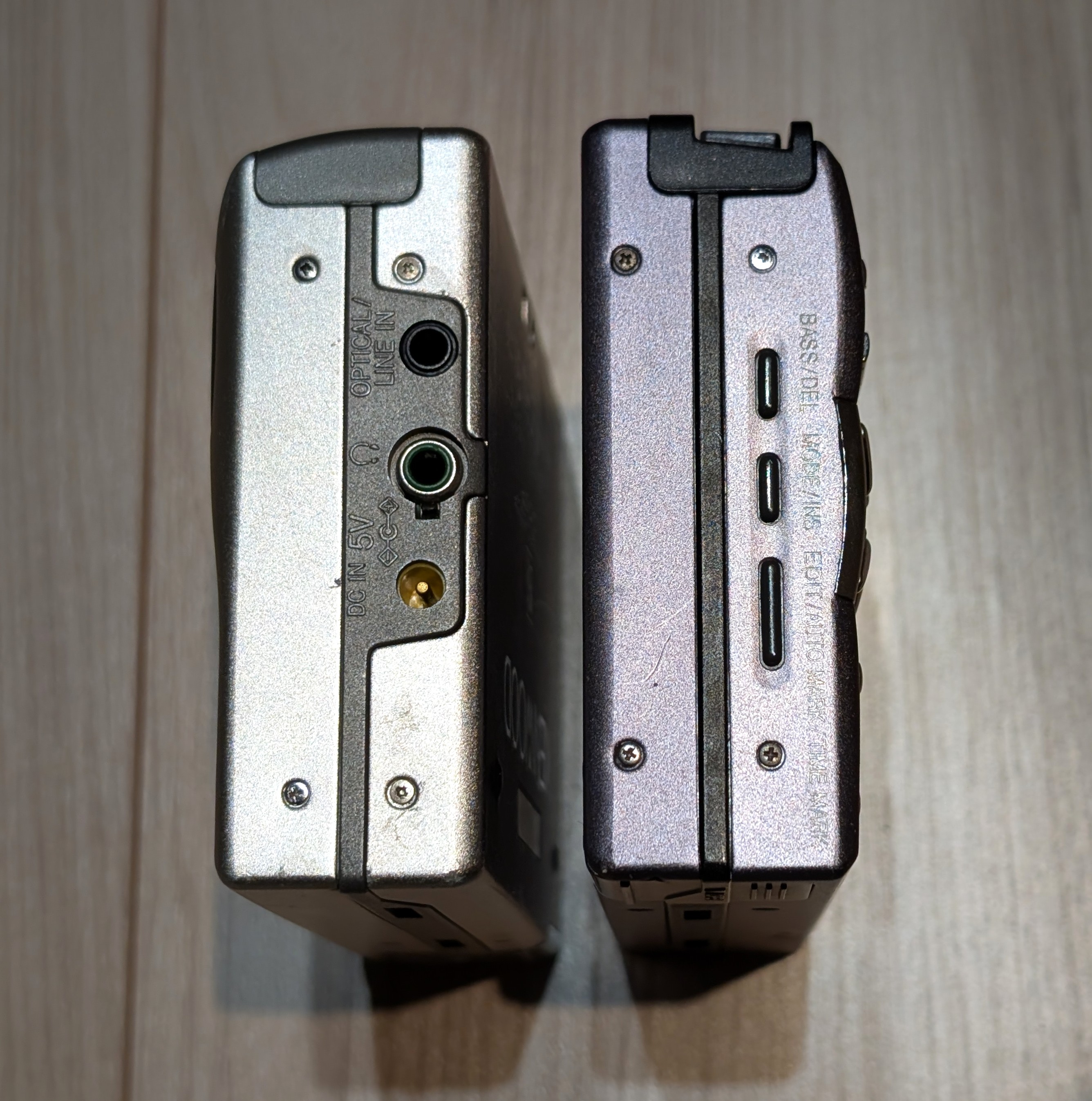
On the left side you have power (5v), headphone, and optical line in. On the right edge you have buttons for bass boost, mode, and edit. The front edge where the slot loading mechanism is accessible includes a mic jack (plug in power) and hold switch.
The included remote lacked a display on the Sharp, but the Kenwood had a racy, stopwatch styled remote that again shows Kenwood knew how to style their units better.
Both are still great-looking units that are satisfying to hold and use for the “dozens of us” still enamored with this physical medium.
Battery Life
Battery life wasn’t amazing, but we’re talking about the early days of MD here, so the fact that you could almost get a full workday out of them was impressive.
The stock lithium battery (AD-MS10BT) was rated at 1400 mAh and allowed for about 9 hours of playback and 7 hours of recording. Modern lithium replacements can provide up to 3000mAh.
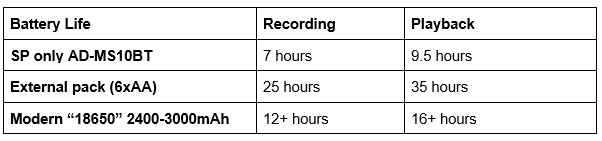
The laughably large (almost as big as the recorder itself) AD-MS10BC battery pack debuted with the previous generation (Sharp MD-MS100) and still worked fine with these models to extend the battery life even further. It used six AA batteries to achieve this, though.
It latched onto the bottom panel securely and had a short wire that ran from the battery pack to the DC input jack.
As you can imagine, these old, original lithium batteries are mostly dead so you’ll want a modern replacement. They are about the size of an 18650, which sadly, isn’t the standard that many people think it is. 18650 is supposed to describe the dimensions of a cell, with 18 being the diameter in millimeters and 65 being the height in millimeters.
However, people play fast and loose with “18650” cells and sizes vary in length +/- 4mm and in diameter +/- 2mm.
With the OEM cell being a flat top, it means you should do some research before buying any 18650. Check out a common 18650 battery store online and you’ll see all the varying shapes and sizes.
The original cell is 70.70mm x 19.70mm x 19.70mm with a flat top. A “standard” 18650 at 65mm will not make good contact with the battery contacts and the smaller diameter may also have it moving around in the battery compartment, adding noise and possibly affecting connectivity.
I’ve done some of the research for you, so please check out my video or blog post if you’re interested in modern replacements that can let you enjoy your device for nearly double the length of the original:
YouTube - Sharp AD-MS10BT battery replacement
Technical Initiative blog - Sharp AD-MS10BT battery replacement
Usage
I love these giant slot-loaders! Let’s just get that out of the way, OK?
I have a lot of devices to choose from but these are rarely out of the weekly rotation. Why? They’re just so satisfying to use!
The solid “thonk” of slotting in a MiniDisc leads to warm, powerful sound from the 10mW + 10mW output. That’s right, these will push fairly demanding headphones and IEMs much more easily than the 3-5mW you might be getting from the smaller, later model players.
Bass boost is there in multiple levels if you need it, but depending on the headphones or IEMs, you may not need it at all.
Yes, these are SP-only units from 1997, so you’ll be swapping MiniDiscs often. I think that’s perfectly acceptable when the eject and slot-in mechanisms are as satisfying as these are.
I often gravitate towards admiring the more “organic” design of the Kenwood DMC-G7R’s controls, while the Sharp MD-MS200 looks like it was designed by a Japanese committee to look good on an office desk. Either way, once you get used to the control layout, it’s easy to operate them without looking.
Both still look great, sound great, and are extremely enjoyable units to listen to. If you don’t yet have one, I’d highly recommend finding one that’s functional. As you know, these older Sharp gears may have seen better days which can lead to the dreaded “TOC ERROR”.
Wrap up
Related Instagram post: Kenwood in use in Japan!
I listen to music to unwind, relax, and enjoy myself, so I’m not looking to deeply analyze all the nuances in a track even if I’m listening with high-end equipment. I prefer a slight low-frequency boost which suits Trance, K-pop and J-pop along with whatever else I feel like. I like my sound dynamic, warm, and fun - never flat, cold, nor analytical.
These units are great if most of your collection is recorded in SP. They have powerful headphone amps, a warm, fun sound, and can last a lot longer with modern replacement batteries. Not only that, they really contribute to the tactile experience of MiniDiscs with large, functional buttons and the “never gets old” slot-in mechanism.
Get one, and you’ll know exactly what I mean.